Rest period advice ranges wildly depending on where you look — some people rest 30 seconds between everything, others rest five minutes on every set "to be safe." The right answer depends on what you're training for, and getting it wrong in either direction quietly undermines your results.
Why Rest Periods Matter More Than People Assume
Rest between sets determines how much of your strength and energy system recovers before the next set. Too little rest and your subsequent sets suffer — you simply can't lift as much weight or complete as many reps, which reduces the actual training stimulus even though you "did the set." Too much rest wastes time without any added training benefit for most goals.
Rest Periods by Training Goal
- Maximal strength (1-5 reps, heavy compound lifts): 2-5 minutes — your nervous system needs substantial recovery between near-maximal efforts.
- Hypertrophy (6-12 reps): 60-90 seconds is well supported by research as a good balance between recovery and workout density.
- Muscular endurance / high-rep work (15+ reps): 30-60 seconds, since the goal is metabolic stress and conditioning rather than maximal force output.
- Supersets (non-competing muscle groups): Minimal or no rest between the paired exercises, with a standard rest after completing both.
These are starting points, not rigid rules — how you feel, your recovery capacity, and your overall fatigue for the session all matter too.
Why Guessing Rest Periods Goes Wrong
Without a timer, rest periods drift — a "quick break" easily becomes four minutes once you check your phone, and a genuinely necessary two-minute rest on a heavy set can get cut short if you're eager to keep moving. Both directions quietly change the actual training stimulus you're getting compared to what you intended.
Stop losing workouts in your camera roll.
SetForge turns saved Instagram & TikTok workout videos into structured, trackable training programs — automatically.
How SetForge's Automatic Rest Timer Removes the Guesswork
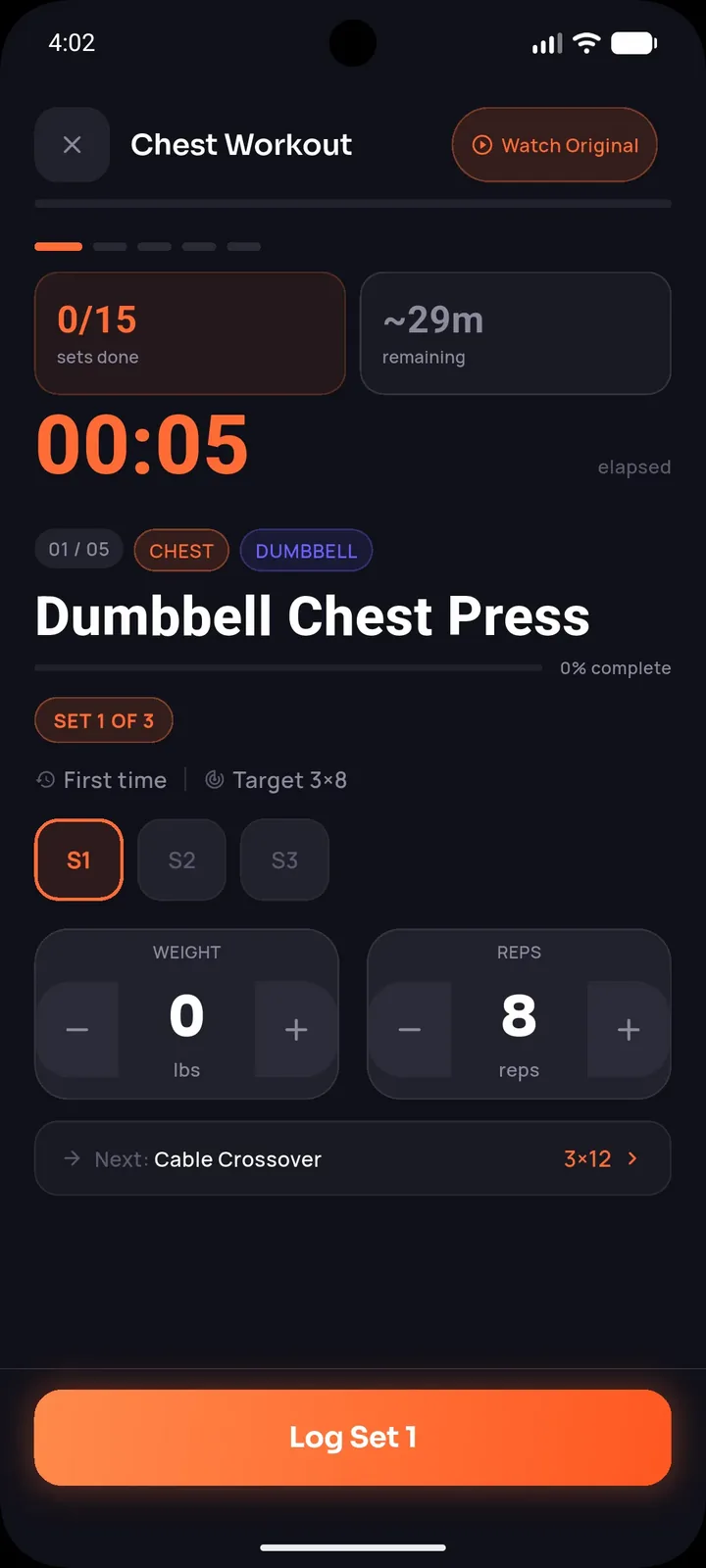
SetForge's Smart Gym Mode includes an automatic rest timer with sound that starts the moment you log a set, so rest periods stay consistent with your actual training goal instead of drifting based on how distracted you are. Because the timer runs automatically and alerts you audibly, you can put your phone down between sets without losing track of time — which, ironically, is what usually causes rest periods to stretch out in the first place.
Adjusting Rest as Fatigue Builds
Rest periods shouldn't necessarily be identical across an entire session — as fatigue accumulates on later sets of the same exercise, or later exercises in general, slightly longer rest can help you maintain quality reps. This is a normal, healthy adjustment, not a sign you're not conditioned enough.
Rest Periods and Workout Duration
Rest time is one of the biggest levers for controlling total workout length without cutting sets. A session with eight sets at 90 seconds rest each adds up to 12 minutes of rest alone — tightening that to a strict, timer-enforced 75 seconds saves real time across a full session without sacrificing the working sets themselves.
Frequently Asked Questions
Is it bad to rest longer than recommended if I feel like I need it?
Occasionally extending rest on a genuinely fatiguing set is fine — the guidance is a general starting point, not a rule to follow rigidly regardless of how you feel.
Does SetForge's rest timer adjust automatically based on the exercise?
Rest periods can be set per workout, and imported workouts carry over rest periods extracted from the source video where available.
Why do heavy compound lifts need longer rest than isolation work?
Heavy compound lifts place greater demand on your central nervous system and require more complete recovery to maintain performance across sets compared to lighter isolation movements.
Can shorter rest periods help with fat loss goals?
Shorter rest increases metabolic stress and workout density, which can be a useful tool alongside overall diet and activity level, though it's not a substitute for those factors.
Should supersets have any rest at all?
Typically minimal or no rest between the two paired exercises in a superset, with a standard rest period after completing both before starting the next round.
The Bottom Line
Rest periods should match your training goal — longer for maximal strength, moderate for hypertrophy, shorter for endurance and metabolic work — and a consistent, timer-enforced approach prevents the drift that quietly changes your training stimulus. An automatic rest timer with sound removes the guesswork entirely, letting you focus on the actual set instead of watching a clock.