Online workout programs are often written in a shorthand that makes complete sense to the person who wrote it and very little sense to everyone else. "5/3/1," "3x8-10 @RPE8," supersets marked with letters — the notation itself becomes a barrier before you've even started training.
Decoding Common Program Notation
- Sets x Reps (e.g., 3x10): Three sets of ten reps each.
- Rep ranges (e.g., 8-12): Aim for somewhere in that range each set, typically stopping a rep or two short of failure unless stated otherwise.
- RPE (Rate of Perceived Exertion): A subjective effort scale, usually 1-10, where RPE 8 means you could do about two more reps if you had to.
- %1RM (e.g., 75% for 5 reps): A percentage of your one-rep max, requiring you to know or estimate that number first.
- Superset labels (A1/A2, B1/B2): Exercises grouped and performed back-to-back with minimal rest between the paired movements.
- Deload week: A planned lighter week, usually reduced volume or intensity, to aid recovery before continuing progression.
What to Do Before Starting an Online Program
- Read the entire program once, fully, before doing a single set — confusion mid-workout is far worse than confusion at your kitchen table.
- Note any %1RM-based prescriptions and calculate your actual working weights in advance.
- Identify any exercises you don't have equipment for and pre-plan substitutions.
- Check the intended weekly schedule against your actual availability before committing.
Stop losing workouts in your camera roll.
SetForge turns saved Instagram & TikTok workout videos into structured, trackable training programs — automatically.
Turning a Confusing PDF Into Something You Actually Follow
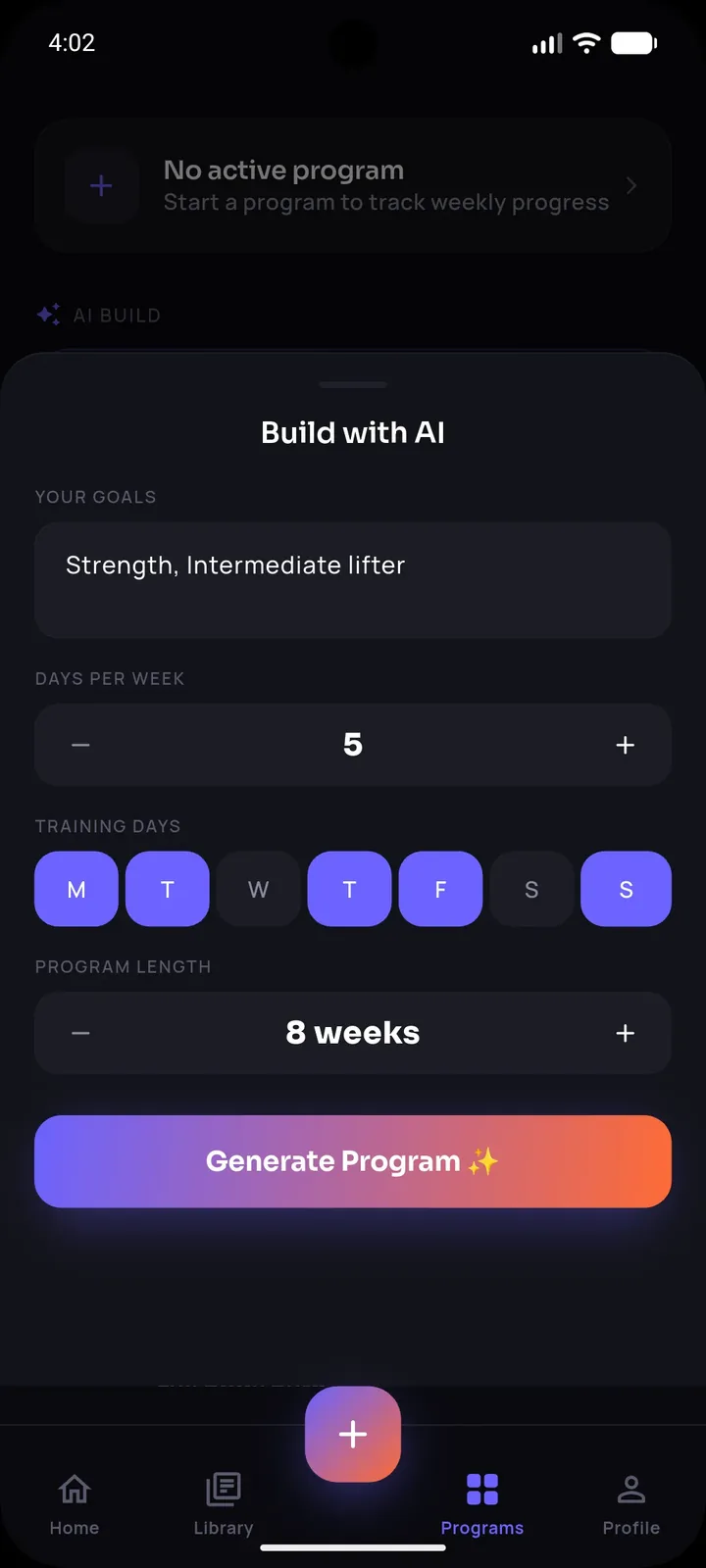
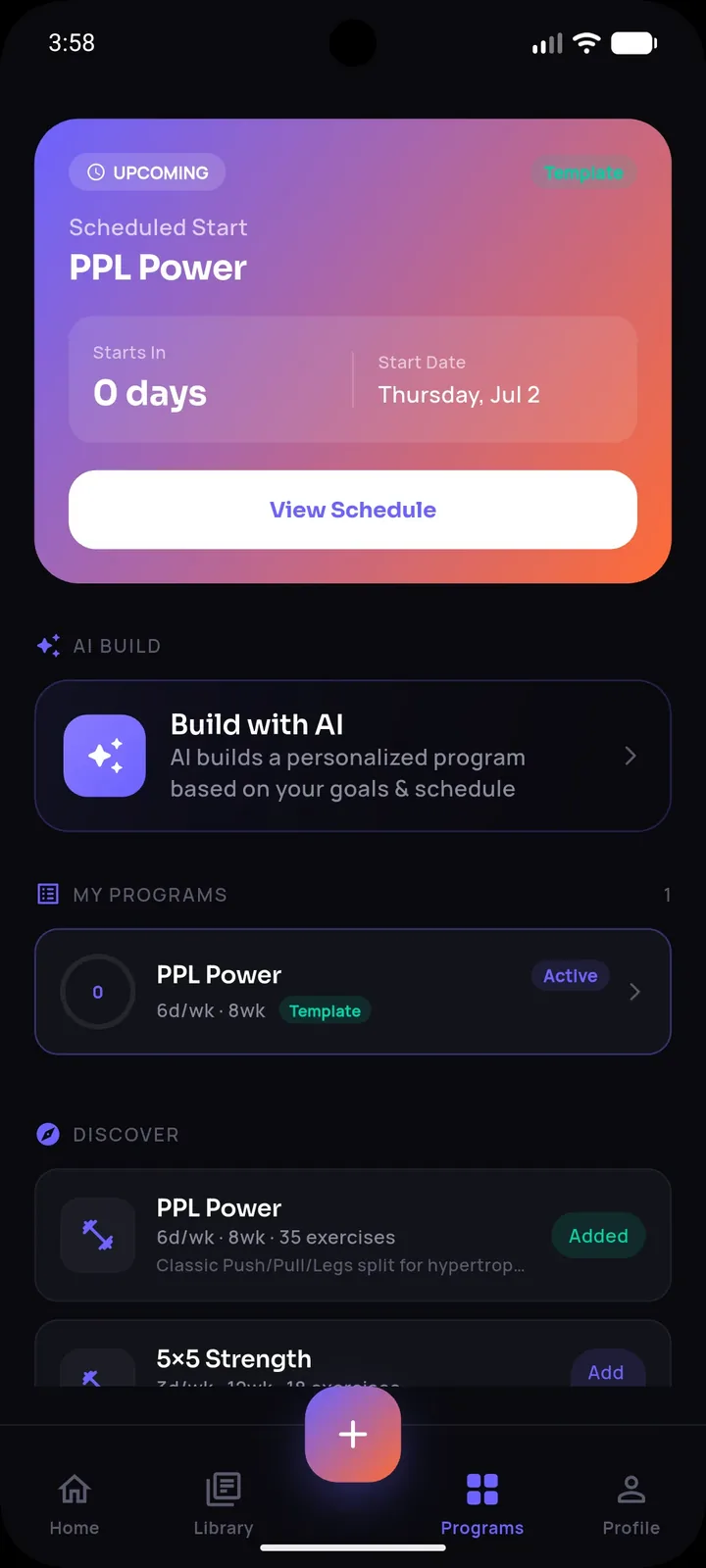
The biggest practical issue with online programs isn't understanding the notation once — it's re-decoding it every single session because it's still sitting in its original confusing format. Once you've translated a program's notation into plain sets, reps, and weights, entering it into SetForge's manual workout builder (backed by a 500+ exercise library) turns it into something you open and follow directly, without re-reading footnotes every time.
If any part of the program involves videos rather than a written PDF, SetForge's AI import can extract the exercises, sets, and reps directly from the video, which is often faster than manually decoding notation from a description alone.
Tracking Progress Against a Program's Intended Structure
Well-designed online programs (like structured strength programs with defined progression schemes) are meant to be followed with actual logged numbers, not just "roughly." SetForge's Progress Analytics tracks training volume and estimated 1RM as you log your actual sets, letting you see whether you're progressing at the rate the program's design intended.
When to Deviate From an Online Program
Not every prescribed number will fit you exactly — if a program calls for a weight you genuinely can't handle safely, scale it down rather than forcing the number. Conversely, if a prescribed weight feels too easy across multiple sessions, it's reasonable to adjust upward even if the program's default progression is more conservative.
Frequently Asked Questions
What does RPE actually mean in practical terms?
It's a subjective 1-10 scale of how hard a set felt — RPE 8 means you likely had about two more reps left in the tank, useful when a program doesn't specify an exact weight.
How do I calculate working weights from a %1RM-based program?
Multiply your known or estimated one-rep max by the given percentage — for example, 75% of a 200 lb estimated 1RM is 150 lbs for that prescribed set.
Can SetForge help me follow a program I found as a written PDF?
You can enter it manually using SetForge's exercise library and Program Builder to structure it into a followable, trackable plan.
What should I do if a program calls for equipment I don't have?
Substitute an equivalent exercise targeting the same muscle group using a filterable exercise library, planning the swap before your session rather than improvising mid-workout.
Is it okay to deviate from a program's prescribed numbers?
Yes, when a prescribed weight is unsafe or clearly too easy — the program's structure matters more than rigidly following every exact number.
The Bottom Line
Online workout programs are often genuinely well-designed but poorly presented for actual day-to-day use. Decode the notation once, convert it into a structured plan you can open and follow directly, and track your real numbers against it — that's what turns a confusing PDF into training that actually works.