Somewhere between "just do bodyweight squats" and "buy a full commercial rack" is where most people actually should be, and almost nobody talks about that middle ground clearly. Building a home gym doesn't require a huge budget or a spare room — it requires buying the right things in the right order, and having a system that adapts your workouts to whatever equipment you currently own.
Why Home Equipment Choices Matter More Than People Think
The biggest mistake in home gym building isn't buying too little — it's buying the wrong things first. A lot of people buy a flashy piece of equipment (a cable machine, a smith machine) before they own the boring basics that get used in almost every single workout. The result is an expensive corner of the garage that gets touched twice a month.
The Equipment Priority Order
If you're building from zero, this is roughly the order that gives you the most training options per dollar spent:
- Adjustable dumbbells — the single highest-value purchase; covers presses, rows, curls, lunges, and dozens of accessory movements.
- A pull-up bar (doorway or wall-mounted) — unlocks vertical pulling, which is hard to replace otherwise.
- Resistance bands — cheap, portable, useful for warm-ups, accessory work, and travel.
- A flat/adjustable bench — massively expands what you can do with dumbbells (incline press, step-ups, single-leg work).
- A barbell + plates — once budget allows, this adds true heavy compound lifting (squat, deadlift, bench).
- A squat rack or stands — needed to safely progress barbell work past moderate weights.
Notice that a cardio machine isn't on this list at all — for most goals, conditioning can be built with bodyweight circuits, and a treadmill or bike is a "nice to have," not a foundational piece.
Building Routines Around What You Actually Have
The real skill isn't owning equipment — it's building routines that make full use of what you have without constantly wishing you had more. A well-designed dumbbell-and-bodyweight-only program can build serious strength and muscle; the limiting factor is almost always programming, not equipment.
- Push day: dumbbell press variations, push-ups, overhead work
- Pull day: pull-ups/rows, band pull-aparts, dumbbell rows
- Leg day: goblet squats, lunges, single-leg RDLs, step-ups
Stop losing workouts in your camera roll.
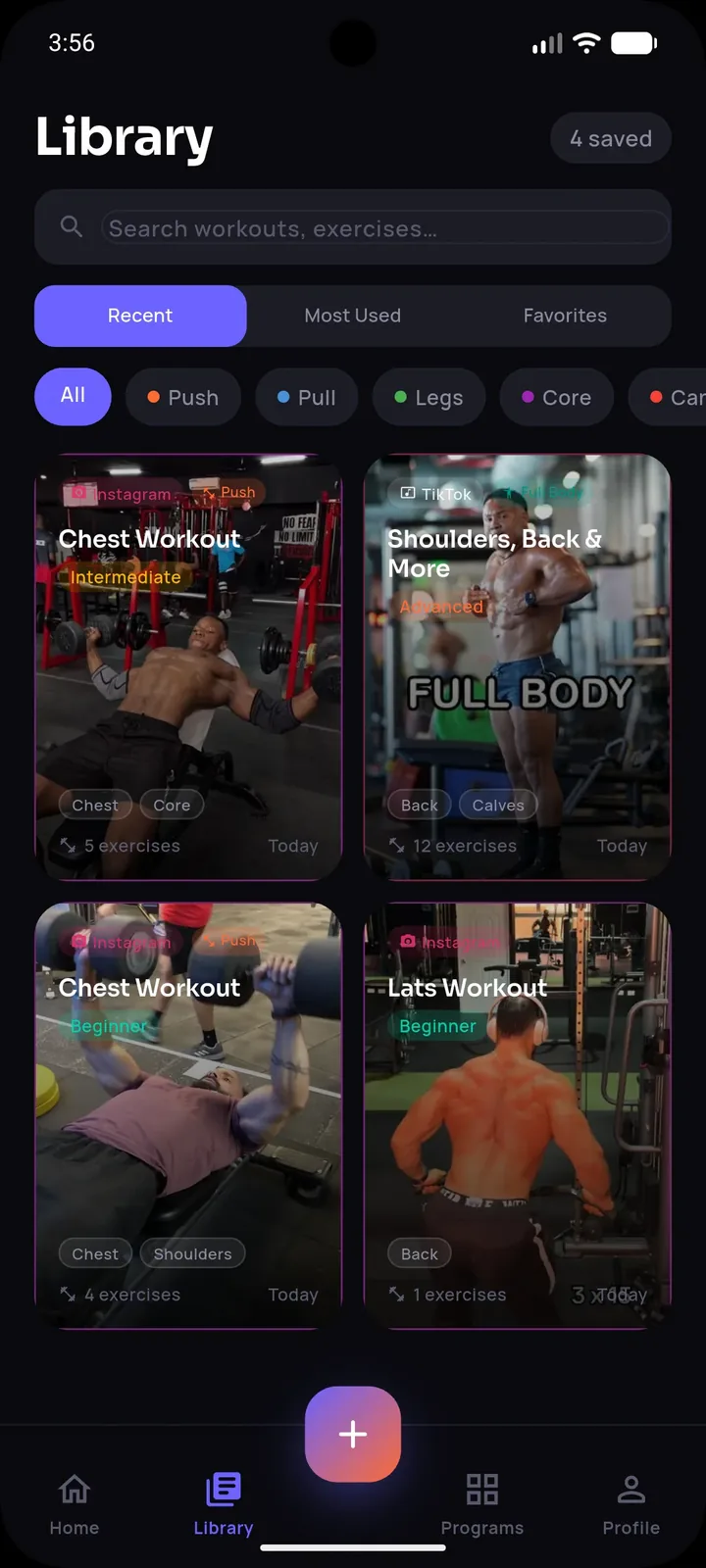
SetForge turns saved Instagram & TikTok workout videos into structured, trackable training programs — automatically.
The Substitution Problem — And How to Solve It
A huge number of saved workout videos assume gym equipment you might not have at home — a cable machine, a leg press, a specific barbell attachment. Rather than skipping the exercise entirely, the better move is substituting an equivalent movement that hits the same muscle group with what you own.
SetForge's 500+ exercise library is filterable by muscle group specifically to make this easy — if a saved video calls for a cable row and you only have dumbbells, you can find a dumbbell row variation targeting the same area in seconds rather than guessing. And when you import a workout video directly into SetForge, its AI extracts the exercises automatically, so you can immediately see which ones need a home-equipment substitution before you start.
Tracking Progress Without a Gym's Machines
One underrated benefit of home training with basic equipment is that progress is easier to measure precisely — you know exactly which dumbbells you used, unlike a gym machine with an unfamiliar weight stack. SetForge's Progress Analytics tracks your training volume and estimated one-rep max over time from logged sessions, which works just as well with a pair of adjustable dumbbells as it does with a full barbell setup.
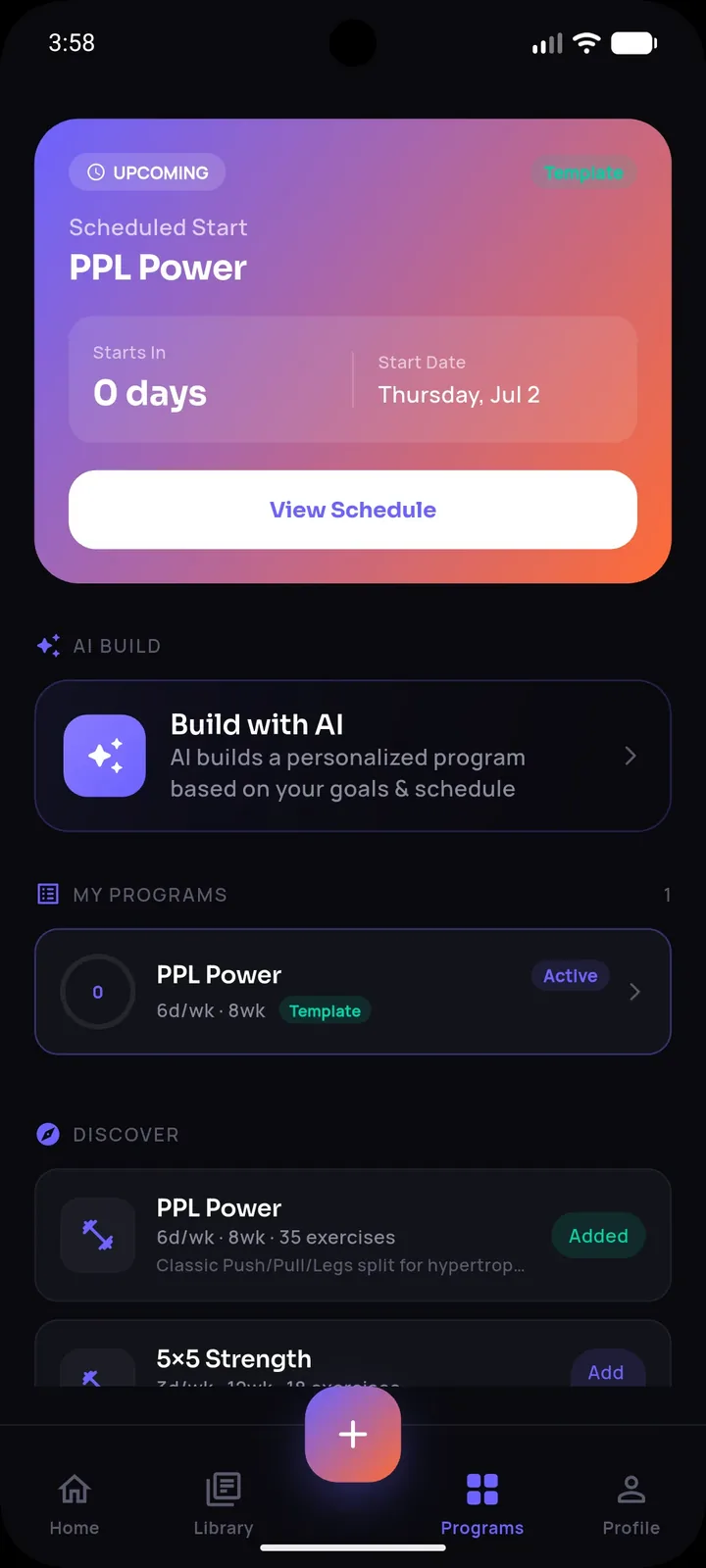
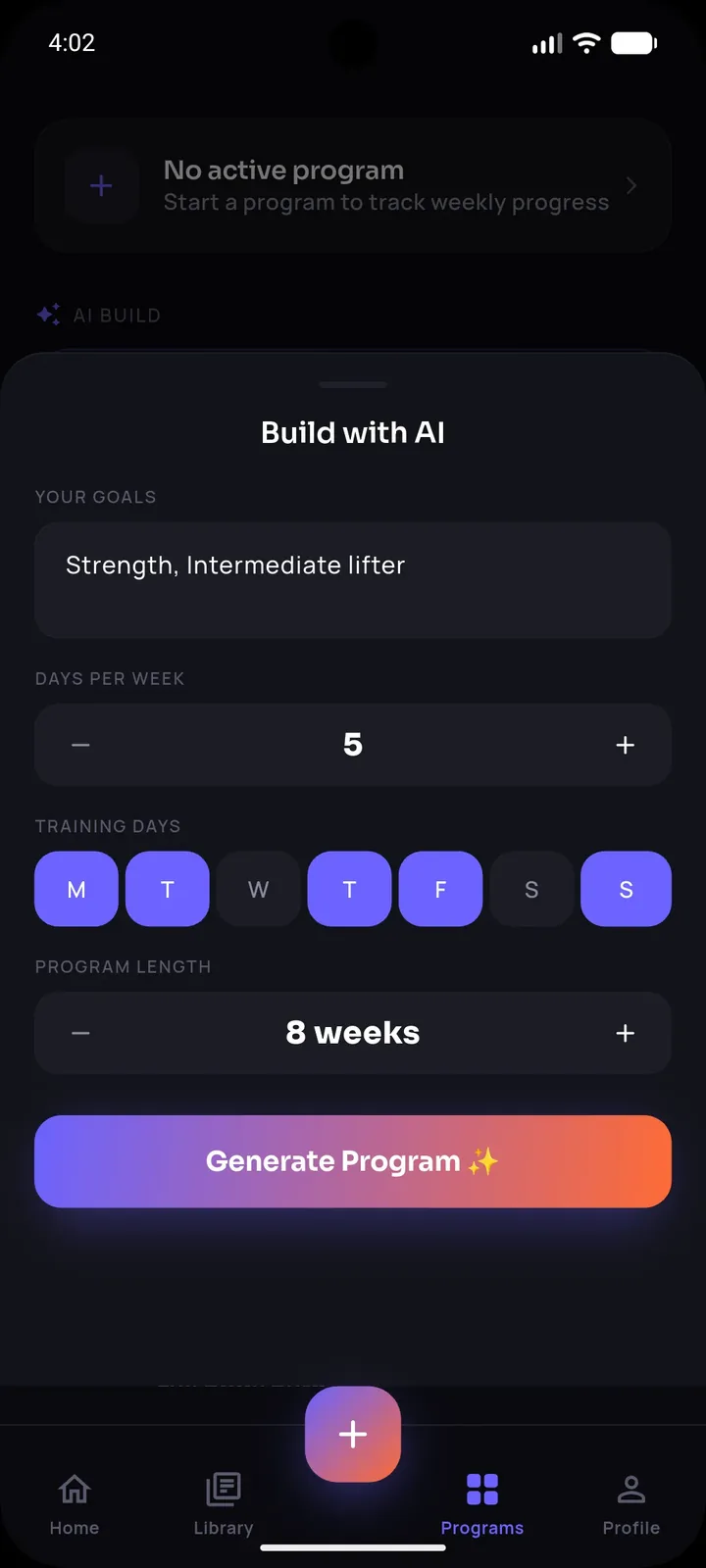
If you eventually add equipment (a barbell, a heavier dumbbell set), your workout history carries over — SetForge's Program Builder lets you adjust an existing multi-week program rather than starting from scratch just because your equipment changed.
A Sample Minimal Home Gym Weekly Split
- Monday — Push: Dumbbell bench press, overhead press, push-ups, tricep work
- Wednesday — Pull: Pull-ups, dumbbell rows, band pull-aparts, curls
- Friday — Legs: Goblet squats, walking lunges, single-leg RDLs, calf raises
- Saturday — Full body/conditioning: Circuit of compound dumbbell movements for a shorter, higher-intensity session
Frequently Asked Questions
What's the single best first purchase for a home gym on a tight budget?
Adjustable dumbbells — they cover the widest range of exercises across every muscle group compared to any other single piece of equipment.
Do I need a squat rack to train legs effectively at home?
No — goblet squats, lunges, step-ups, and single-leg RDLs with dumbbells can build significant leg strength before a rack becomes necessary.
How do I follow a gym-based workout video if I don't have the same equipment?
Import the video and swap any gym-specific exercises for an equivalent from a muscle-group-filtered library — SetForge's 500+ exercise library makes finding an equivalent home-friendly substitution fast.
Is bodyweight training enough, or do I need to buy equipment eventually?
Bodyweight training can take you a long way, especially early on, but adding load (dumbbells, a barbell) eventually becomes necessary to keep progressing strength once bodyweight exercises stop being challenging.
Can I track progress accurately without gym machines?
Yes — dumbbell and barbell work is often easier to track precisely than machines, since you know the exact weight used every time, and SetForge's analytics work the same regardless of equipment type.
The Bottom Line
An effective home gym isn't about buying everything — it's about buying the right basics in the right order and building a system that adapts saved workouts to your actual equipment. Start with dumbbells and a pull-up bar, use a filterable exercise library to substitute confidently, and track your numbers so "home workout" never means "untracked workout."