Plateaus rarely announce themselves clearly. Most people don't have a single dramatic moment where a lift stops moving — instead, progress just quietly slows without anyone noticing for weeks, because without solid tracking, "about the same as last month" can look a lot like "still making progress" from memory alone.
Sign 1: Your Logged Numbers Haven't Moved in 3+ Weeks
The clearest sign, and the reason logging matters — if your working weight, reps, or estimated 1RM on a key lift has been flat for several consecutive sessions, that's a genuine plateau, not a rough week. Fix: Try adjusting a variable other than weight — an extra set, a slight rep increase, or a short deload followed by a fresh push.
Sign 2: Every Session Feels Equally Hard, Regardless of Load
If a lighter working weight feels just as taxing as it did when it was genuinely challenging months ago, accumulated fatigue may be masking your actual capacity. Fix: A deload week — reduced volume and intensity — often reveals that you're stronger than recent sessions suggested, once fatigue clears.
Sign 3: Muscle Group Volume Has Quietly Dropped
Sometimes a plateau isn't about intensity at all — it's that total weekly volume for a muscle group has drifted down without you noticing, often because a program has shifted focus elsewhere. Fix: Check your actual logged weekly volume per muscle group and compare it to what it was during your last period of visible progress.
Sign 4: You've Run the Same Program for 6+ Months Unchanged
Programs that were productive early on eventually stop providing enough novel stimulus for continued adaptation, especially past the beginner stage. Fix: Introduce program variation — a new rep range, a different exercise variation for the same muscle group, or a new overall split.
Stop losing workouts in your camera roll.
SetForge turns saved Instagram & TikTok workout videos into structured, trackable training programs — automatically.
Sign 5: Motivation Has Dropped Alongside Performance
Plateaus aren't just physical — a stretch of flat progress often coincides with declining motivation, since visible improvement is one of the biggest drivers of training enthusiasm. Fix: Sometimes the most effective intervention is a short break or a deload combined with trying a genuinely new stimulus (new exercises, a new format) to rebuild both progress and enthusiasm together.
How SetForge Helps You Spot Plateaus Before They Drag On
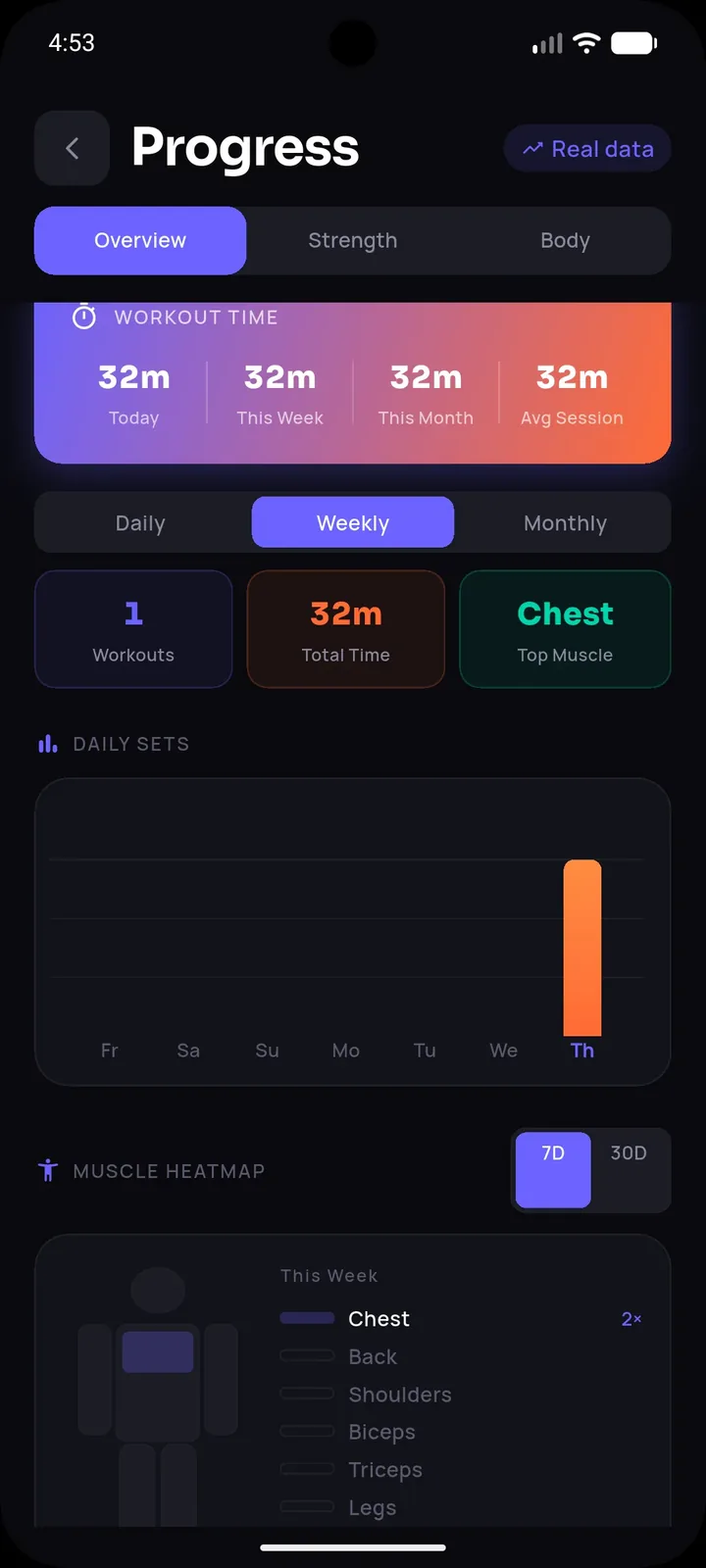
SetForge's Progress Analytics — training volume, strength progression, estimated 1RM, and muscle group breakdown — makes plateaus visible as an objective trend rather than a vague feeling. Instead of wondering whether you're actually stuck or just having an off week, you can look at several weeks of logged data and see clearly whether a lift or muscle group has genuinely stalled. SetForge's AI Coach can also reference this history directly, giving you a specific, data-grounded explanation for why a plateau might be happening and what to adjust.
Frequently Asked Questions
How long does a lift need to be flat before I call it a plateau?
Generally 3 or more consecutive weeks of no progress on a key lift, assuming training and recovery have otherwise been consistent.
Is a deload always the right fix for a plateau?
Not always, but it's a reasonable first step when accumulated fatigue seems to be the cause — if volume or program staleness is the actual issue, other adjustments may be needed instead.
How does SetForge help identify which type of plateau I'm experiencing?
Its Progress Analytics shows strength progression and volume by muscle group over time, making it possible to distinguish a genuine strength stall from a volume or program-staleness issue.
Can motivation loss actually be a sign of a physical plateau?
Yes — declining motivation often correlates with a genuine lack of visible progress, and addressing the underlying plateau can help restore motivation alongside performance.
Should I change my entire program at the first sign of a plateau?
Not necessarily — try smaller adjustments (extra sets, a deload, minor variation) first before overhauling an entire program that may otherwise still be working.
The Bottom Line
Plateaus are often subtler than a single obviously stalled lift — flat volume, rising perceived difficulty at the same weight, or a stale unchanged program can all be quiet signs. Logging consistently and reviewing your actual trend data is what makes these signs visible early, before months pass without anyone noticing.